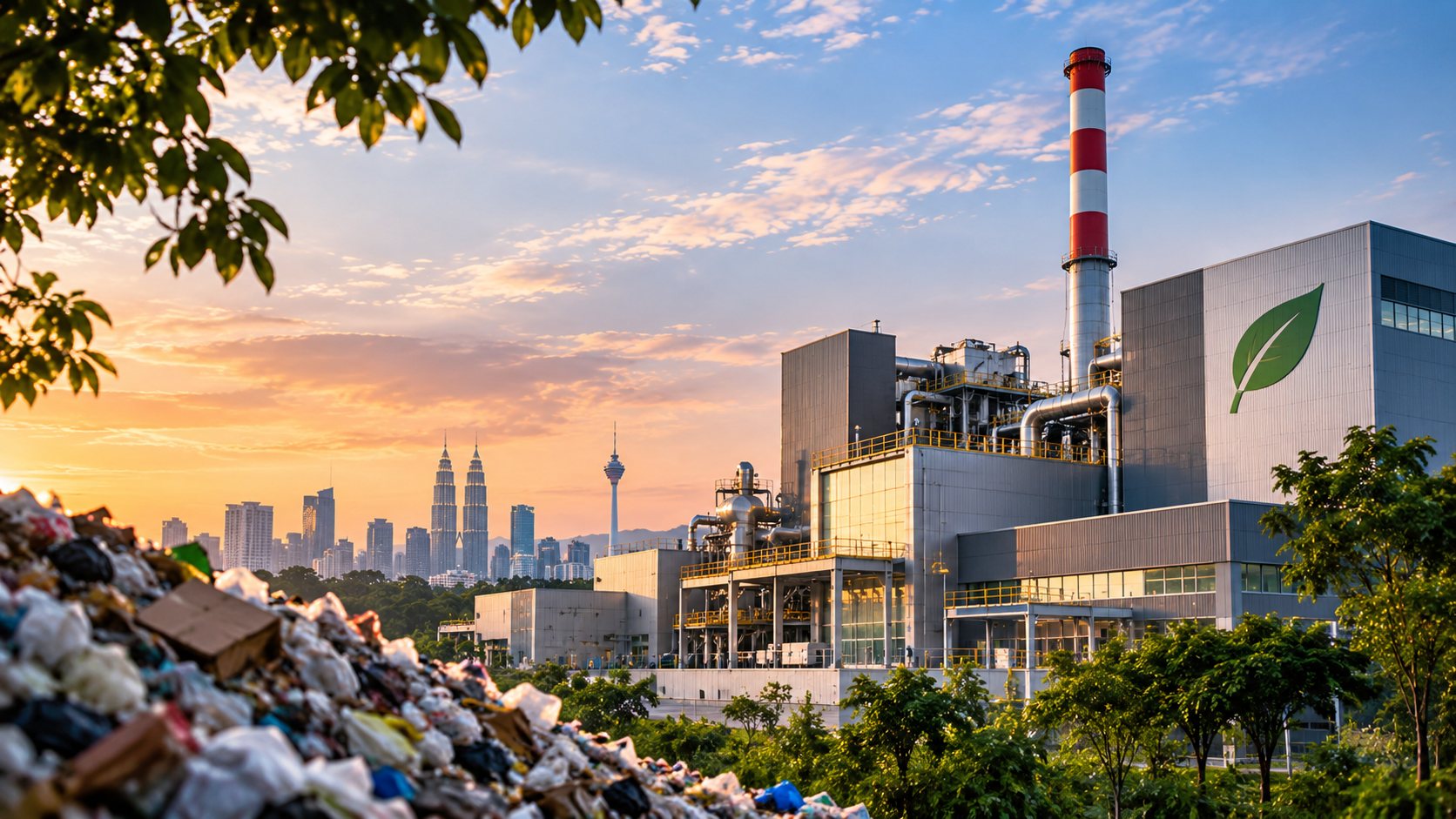
Malaysia is tackling its waste challenge by constructing 18 waste-to-energy (WTE) plants nationwide by 2040. The initiative aims to divert up to 85 per cent of landfill-bound waste and generate up to 600 MW of electricity. [1] The Jeram plant in Selangor began commercial operations in May 2026, processing up to 1,700 tonnes of waste daily for 26 MW. A second unit will be completed this year, a third is underway at Tanjung Dua Belas, and a RM660 million plant at Sungai Udang in Melaka, with Malakoff as the main investor, is scheduled to operate from 2029. [1][3]
Malaysia has over 130 landfill sites, but only about 15 per cent are sanitary; the rest are open dumps. Waste volume is rising by about 5 per cent annually. [1] Selangor alone generates 7,000 to 8,000 tonnes of domestic waste daily. [1] With limited land and environmental risks from methane and leachate, expanding landfills is no longer viable. In this context, WTE plants that reduce waste volume and generate electricity are a logical solution.
The objection and its basis
However, this approach is contested. Analyses indicate that incineration may not be as clean as it appears. A recent study of Delhi's WTE plants by Indian researchers estimated about 3.4 kg of fossil-origin CO₂ per kilowatt-hour of electricity exported, roughly 4.7 times the carbon intensity of India's grid average and 3.5 times that of coal. This is mainly due to the waste stream's high plastic content. [2] Malaysian environmental groups have highlighted these findings: Sahabat Alam Malaysia states that incineration facilities "emit significant greenhouse gases, toxic air pollutants and hazardous ash." Zero-waste advocates also argue that prevention, reuse, recycling, and composting are preferable alternatives. [2]
These figures are specific to Delhi and should not be directly applied to Malaysia. However, the underlying mechanism is universal: a WTE plant's carbon emissions and economics depend mainly on its feedstock, not the technology. If a plant processes waste with high plastic content, it will emit more fossil carbon and may have higher emissions per kilowatt-hour than coal. If it receives only residual waste, after recyclables and organics are removed, its impact is significantly different.
The key issue: implementation
The debate is often framed as incineration versus zero waste, but the real issue is sequencing. Reduction, reuse, recycling, and composting should take priority, with WTE reserved for residual waste that would otherwise go to open dumps. The main risk is that long-term incineration contracts could discourage waste separation. If sequencing is mismanaged, Malaysia could face decades of burning plastic that should have been diverted.
The key questions for Malaysia's WTE strategy concern feedstock and transparency, not just technology. Is upstream separation and recycling being strengthened alongside plant development, or undermined by it? What is the feedstock composition, particularly its plastic content? Waste specialists also emphasise the need for transparency regarding 30-year concessions: construction costs, concession periods, and the per-tonne processing cost paid through tipping fees. [1] A WTE plant's effectiveness depends on the broader system, which is determined by policy and execution rather than engineering.
| Project / milestone | Capacity | Power | Status |
|---|---|---|---|
| Jeram WtE 1, Selangor | up to 1,700 t/day | 26 MW | Operating (May 2026) |
| Jeram WtE 2, Selangor | — | — | Completing 2026 |
| Tanjung Dua Belas (WtE 3), Selangor | — | — | In execution |
| Selangor cluster (3 plants combined) | 5,500 t/day | 90 MW | ~RM2bn · 30-year concession |
| Ladang Tanah Merah, Negeri Sembilan | — | — | First large-scale commercial plant |
| Sungai Udang, Melaka | — | — | RM660m · operational 2029 |
| National ambition by 2040 | divert up to 85% from landfill | up to 600 MW | 18 plants nationwide |
Implications for investors, developers, and public finances
For investors and developers, a WTE concession is a long-term infrastructure asset whose viability depends on two factors: a guaranteed waste supply and a stable tipping-fee structure over thirty years. Both can conflict with national recycling goals and carry significant carbon exposure. As carbon pricing becomes more prevalent in the region, a plant with emissions higher than coal faces stranded-asset risk. The feedstock issue is therefore central to the asset's value, not just an environmental consideration.
For public finances, transparency is essential. A 30-year commitment funded through tipping fees requires the disclosures waste specialists are requesting, so the true cost of converting waste to energy can be compared to the cost of recycling.
As discussed throughout this series, Southeast Asia's infrastructure success depends on execution, not ambition. Malaysia's waste-to-energy programme can address a real crisis, but only if it serves as the final step in a comprehensive waste system, not as a substitute. If you are considering this issue, we welcome further discussion. Talk to us →
Sources
- The Star — “Malaysia bets on waste-to-energy technology” (26 June 2026: national plan of 18 WTE plants by 2040, up to 600 MW and 85% landfill diversion; 130+ landfills (≈15% sanitary); waste rising ≈5%/year; Selangor 7,000–8,000 t/day; Jeram and Selangor-cluster figures; tipping-fee and disclosure points)
- Sahabat Alam Malaysia (Friends of the Earth Malaysia) — “Malaysia's Expanding Waste-to-Energy Plans Raise Climate Concerns, as Delhi Report Finds Incinerators Carry High Fossil-Carbon Burden” (29 October 2026: Delhi study estimate of ≈3.4 kg fossil CO₂/kWh (≈4.7× grid, ≈3.5× coal); SAM/CAP objections; zero-waste position)
- The Star — “Second Waste-to-Energy plant to operate from 2029, says Nga” (19 June 2025: timeline for the second national WTE plant)
- Centre for Financial Accountability / NACEJ — “The Climate Cost of Burning Waste” (the underlying Delhi WTE study)
Part of the Ezra & Macquarie Insights series on where capital, risk and capability are moving across Asia.