Operators and investors should focus on a key figure unrelated to commissioning price: by the midpoint of design and specification, about 80% of an asset's lifetime cost is already determined. This includes operating, energy, maintenance, spare parts, and disposal costs incurred over decades. [2] The cheque is written at commissioning; the bill is written at the drawing board.
This reversal — costs decided early but incurred later — is the most effective way to assess whether an energy or industrial asset will deliver on its projected returns. Corrosion illustrates this principle most clearly.
The cost that compounds in the dark
Corrosion is a significant expense. NACE International's IMPACT study estimates its annual global cost at about US$2.5 trillion, or 3.4% of global GDP, and suggests that established corrosion-management practices could prevent 15 to 35% of these losses, saving US$375–875 billion annually. [1] The key insight is that most of this loss is avoidable, resulting from decisions not made early enough.
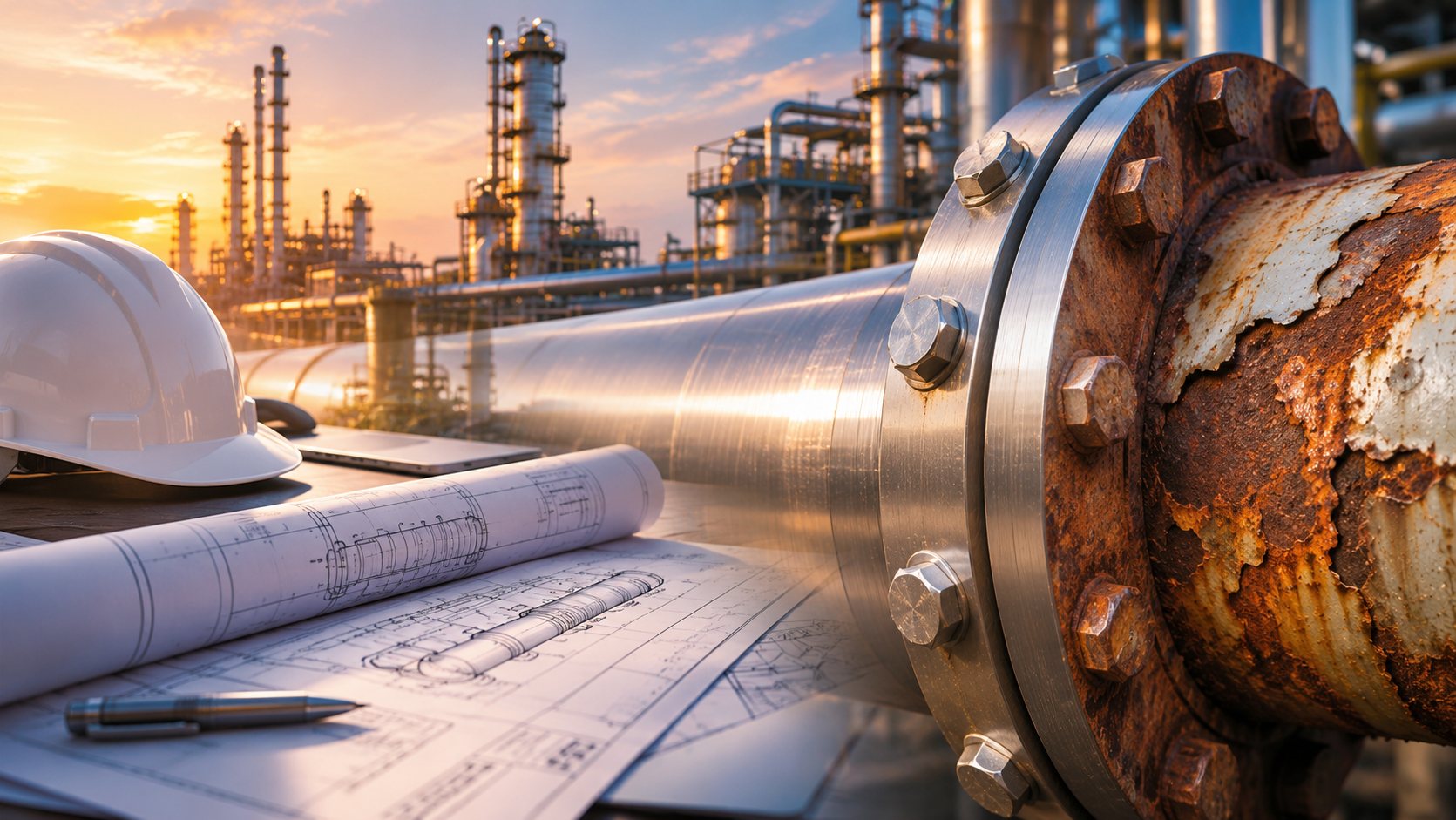
The most severe corrosion often goes unnoticed. Corrosion under insulation (CUI) affects pipework and vessels beneath insulation, where trapped moisture against hot metal makes inspection difficult and costly. Industry estimates attribute 40 to 60% of pipework maintenance costs in process plants to CUI, which is considered a major integrity issue in oil and gas due to its detection challenges. [3][4] This exemplifies the design-stage principle: early decisions on insulation, coatings, cladding, and inspection access create long-term maintenance and safety liabilities.
Why the later you look, the more it costs
The cost of correcting integrity decisions increases sharply over time. According to reliability literature, a change during design costs a baseline amount; late in design, about ten times more; after contract signing, roughly one hundred times more; and after years of operation, up to one thousand times more. [2]
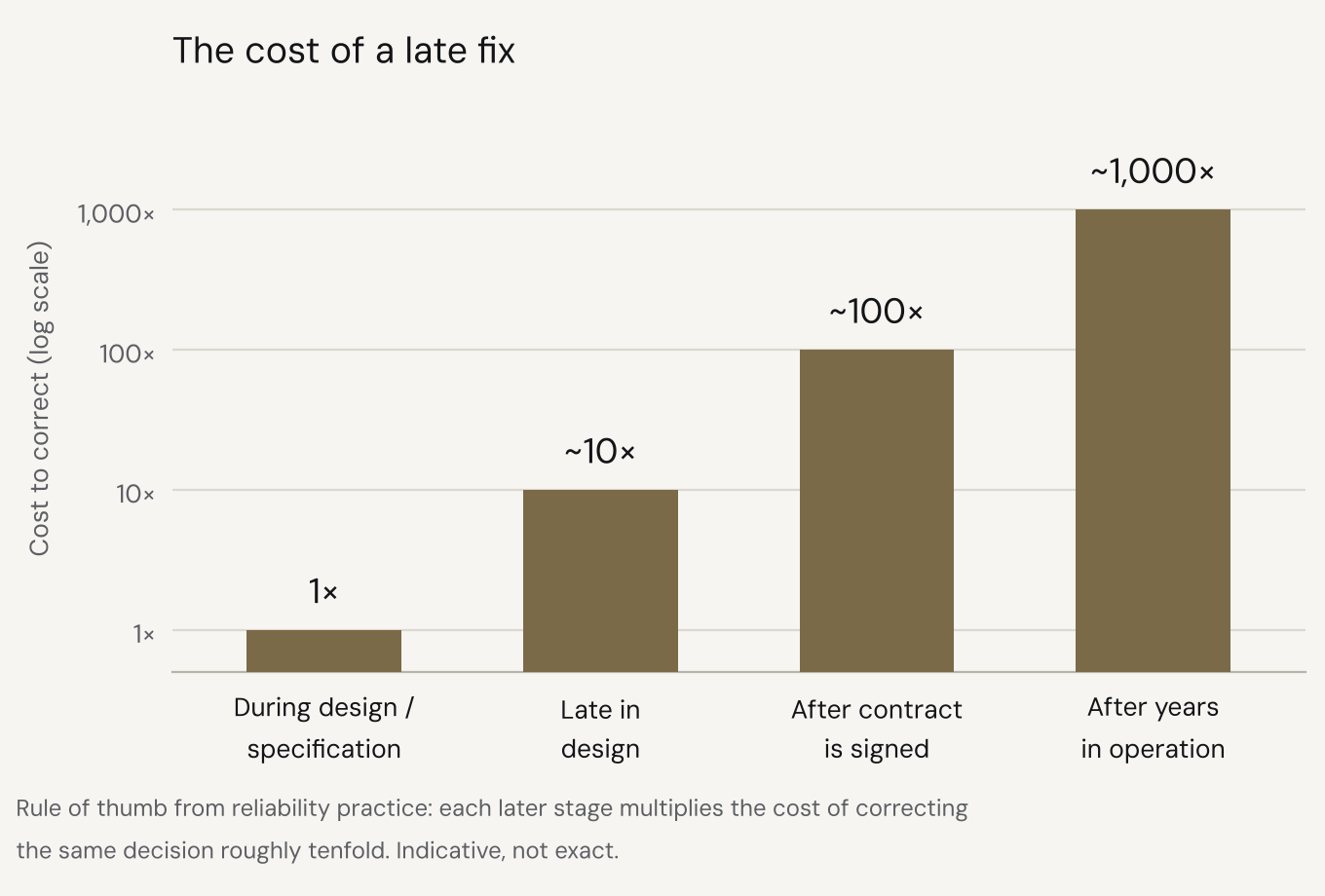
These are guidelines, not precise values, but the trend is widely recognized by maintenance managers. Delaying inspection rarely saves money; it simply defers costs at a much higher rate.
Southeast Asia intensifies this challenge
The region's climate accelerates failures that early specification could prevent. Persistent heat and humidity, combined with coastal exposure to chloride-laden air, affect much of Southeast Asia's energy and industrial infrastructure, including refineries, gas processing, petrochemicals, and offshore facilities, all of which use hot, insulated pipework where CUI is prevalent. The issue extends beyond oil and gas; for example, palm-oil mills handling hydrogen sulphide face aggressive corrosion, and light-rail systems encounter their own integrity and groundwater risks. In every case, the key question remains: were materials, coatings, drainage, and inspection access specified for the actual environment or just for the design?
What it means — for investors and operators
For investors, asset integrity is not a minor technical detail but a key factor influencing returns that can be assessed early. Due diligence should ask not only "what did it cost to build?" but also "how much of its lifetime cost was wisely committed at design, and how much risk remains uninspected under the insulation?" An asset with a credible integrity strategy — specified for its environment, with a matching inspection plan and maintenance history — presents a different risk profile than one that only appears complete.
For operators, the priority is to address integrity early. The most cost-effective corrosion is prevented at the design stage; the next best is detected through proactive inspection rather than after a failure. Managing integrity as a design and whole-life discipline — using recognized standards for materials and coatings, ensuring inspection access, and conducting independent inspections before cladding — is where significant lifetime cost savings are achieved.
This principle underpins all our work: in Southeast Asia, success favors those who make the right decisions early, not necessarily those who spend the most. Asset integrity exemplifies this — costs are determined at design and paid, with interest, during maintenance. If you are considering this issue, we welcome the opportunity to discuss it with you. Talk to us →
Sources
- Inspectioneering, reporting NACE International's IMPACT study — “NACE Study Estimates Global Cost of Corrosion at $2.5 Trillion Annually” (global corrosion cost ≈ US$2.5 trillion, ≈ 3.4% of global GDP; 15–35% / US$375–875bn potential savings from corrosion management)
- Christer Idhammar, IDCON Inc., Reliable Plant — “Life Cycle Cost and Design” (≈80% of life-cycle cost locked in by the design-specification stage; cost-to-correct escalation of roughly 10×/100×/1,000×)
- Vidya — “Challenges and Opportunities of Corrosion Under Insulation (CUI)” (CUI estimated at 40–60% of pipe maintenance costs; detection difficulty)
- ResearchGate — “A Review of Corrosion under Insulation: A Critical Issue in the Oil and Gas Industry” (CUI as a critical, hard-to-detect integrity problem in process industries)
Part of the Ezra & Macquarie Insights series on where capital, risk and capability are moving across Asia.