The key figure is not the tax itself, but the sum leaving the country without one. By one estimate, CBAM will take close to RM970.7 million from Malaysia's iron and steel industry in 2026 alone — the first full year in which the charge is actually levied. [4] And because the EU's carbon price has climbed almost 9 per cent across the year, that exposure is deepening rather than easing. That is the real measure of the capital at stake for Malaysian exporters.
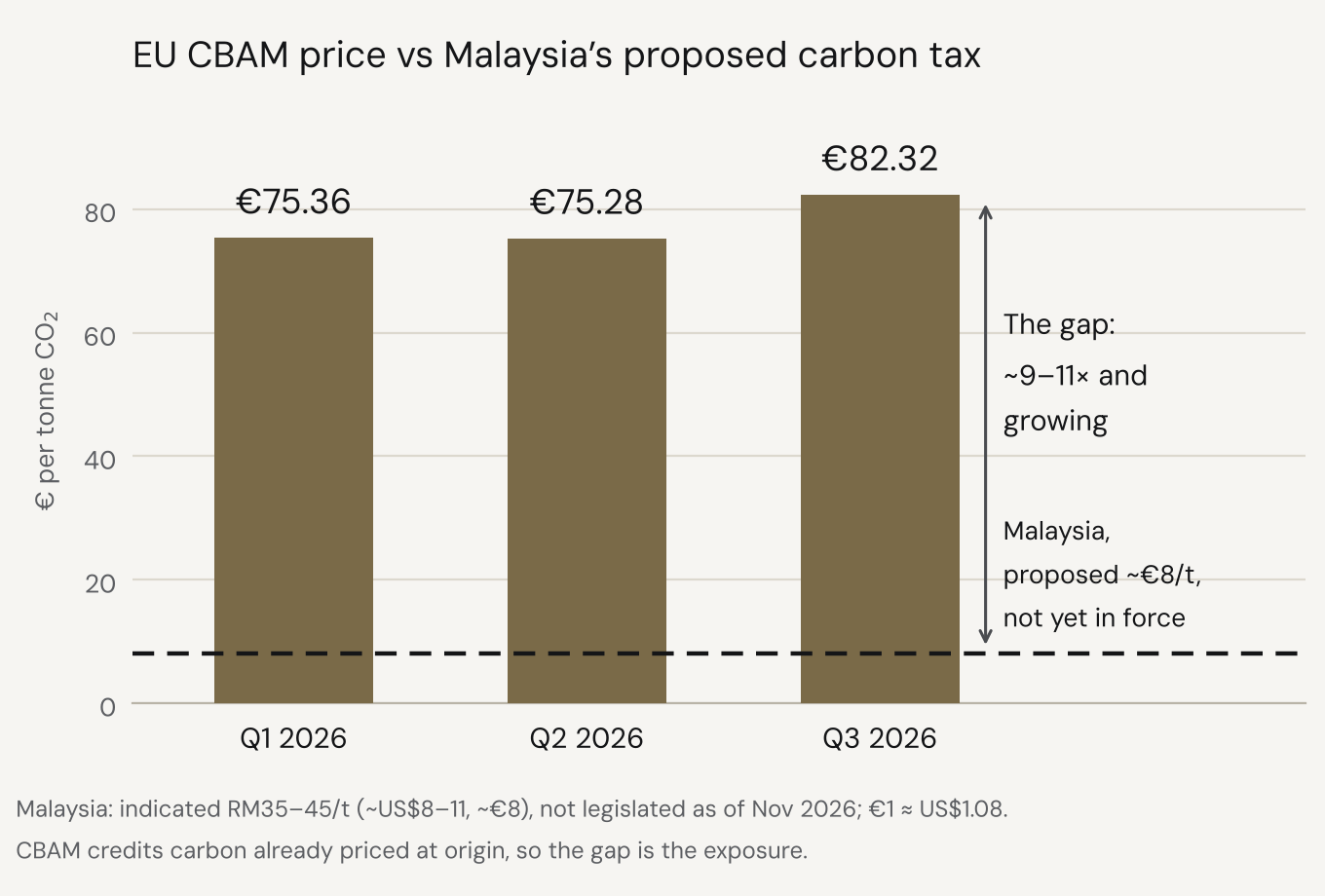
When the European Union's Carbon Border Adjustment Mechanism moved into full effect on 1 January 2026, it put a price on the carbon embedded in imported steel, aluminium, cement and fertiliser. [5] The EU publishes that price quarterly, tracking its own carbon market. It opened the year at €75.36 per tonne, held near that level through the second quarter, then climbed to €82.32 in the third quarter of 2026. [1] For a Malaysian steel producer selling into Europe, the cost of the carbon in that steel is not a future risk. It is a live charge, and over the course of this year it has risen by roughly nine per cent.
Despite extensive preparation over two budgets, Malaysia's own carbon tax has yet to be implemented.
The tax that has not landed
The measure was first set out in Budget 2025 and reaffirmed in Budget 2026 as a levy to take effect “by 2026”, beginning with the iron, steel and energy sectors, at a rate indicated in advisory coverage — though never gazetted — of around RM35 to RM45 per tonne. [2][6] As 2026 closes, none of that has become law. No rate has been set, no commencement date fixed, and officials have signalled that the timing itself “may be reviewed” amid geopolitical as well as economic pressures. [2] The government's stated sequence now puts the National Carbon Market Policy — a framework for trading verified carbon credits — ahead of the tax, on the view, as the environment ministry has put it, that a working carbon market and reliable emissions data should come before a penalty tax. [2][3] The Climate Change Bill that would create the monitoring, reporting and verification backbone for any of this remains pending. [2]
This sequencing has a valid rationale and should be acknowledged rather than written off as mere delay. A carbon price is only as credible as the underlying measurement; imposing a tax before reliable emissions accounting is in place would be counterproductive, and introducing it in a period of economic uncertainty might be costly. The review is not simply indecision. But the timeline that matters is not determined in Putrajaya.
The logic the climate framing hides
The reason the domestic tax matters more than its modest proposed rate suggests lies in how CBAM is built. A European importer of Malaysian steel must account for the carbon embedded in it at the CBAM price — now €82.32 per tonne, some eight to eleven times the level Malaysia had contemplated charging at home. [1] Crucially, CBAM allows that importer to deduct any carbon price already paid in the country of origin. Every ringgit Malaysia charges its own producers is therefore a ringgit the European Union cannot charge on the same tonne.
Viewed this way, a domestic carbon tax on export-bound steel does not increase the sector's total cost for selling into Europe. Instead, it shifts part of the cost from a certificate surrendered in Brussels to a levy collected in Putrajaya, where it can be reinvested in Malaysia's own transition rather than Europe's. The burden is not evenly spread: facilities whose sales are heavily EU-focused are far more exposed than diversified ones, and the Malaysian Steel Institute's estimate — cited by the Ministry of Investment, Trade and Industry in a parliamentary response — is expected to climb as the CBAM price rises. [4] Without a domestic price, that money leaves the country, and the amount at risk grows with every quarter the tax is delayed.
The offset applies only to production sold into CBAM-covered markets. Steel sold domestically, or to markets without border carbon pricing, receives no such credit, making a domestic tax a real additional cost for that output. The case for a domestic carbon price is not that it is cost-free, but that, for a trade-exposed economy, it turns an unavoidable and rising external charge into recoverable domestic revenue. Each quarter without one shifts more of that revenue to Brussels.
The execution gap, made literal
Readers familiar with our previous work will recognise this problem; this year, it has simply become concrete. The ambition was clear and announced; the execution — measurement, verification, legal framework and political timing — has not materialised, so the policy remains unimplemented. The systems required for a credible carbon price and for CBAM compliance are the same: installation-level emissions accounting, verification to a standard a European customs authority will accept, and a data trail to support deduction claims. Malaysia is developing these through its carbon market policy and pending legislation, but they are not yet widely established across industry.
For investors and operators assessing readiness, a few practical criteria help. Can the facility produce complete and accurate greenhouse-gas inventories, preferably audited by a recognised third party? Are emissions tracked at the installation level, with supporting documentation traceable over several years? Is there a system for regular verification aligned with international standards such as ISO 14064 or the EU ETS? Digital monitoring and external verification reports are a clear signal that an asset is prepared for current and forthcoming requirements; facilities without them face a steeper path to compliance.
Firms that use this period for preparation, rather than delay, will be better placed to control costs and protect their European margins when the domestic tax is implemented. Those waiting for the statute to be enacted will find that CBAM is already in effect, with the border charge rising regardless of domestic policy status. The binding constraint, as ever, is not the policy. It is readiness.
What it means — for investors and industrial operators
For investors in Malaysian heavy industry, the key question is no longer whether or when Malaysia will introduce a carbon tax. It is which assets can verify their embedded emissions, and which are already paying the CBAM charge without an offset to show for it. That distinction determines which operators can protect their European margins, and it can be assessed now, regardless of future policy decisions.
To address exposure proactively, investors can take immediate steps: request up-to-date emissions data and verification reports from portfolio companies, engage operators directly on their CBAM readiness, and fold carbon-compliance criteria into ongoing due diligence and monitoring. These actions surface vulnerabilities, improve transparency, and position portfolios to respond as either the domestic tax or further border charges take effect.
For the industrial operator, the priority is to be carbon-ready before the price takes effect: build the emissions inventory, stand up monitoring and verification, and identify where CBAM exposure and any future domestic liability intersect. This is the work Ezra & Macquarie undertakes with clients across the region's industrial base, helping turn a compliance obligation into a defensible commercial position. As we have emphasised throughout this series, advantage in Southeast Asia's transition rarely goes to those with the most ambition; it goes to those who are ready first. If that is a question on your desk, we would welcome the conversation. Talk to us →
Sources
- European Commission, Taxation and Customs Union — “Price of CBAM certificates” (quarterly 2026 prices: Q1 €75.36, Q2 €75.28, Q3 €82.32, published 5 Oct 2026).
- Negaraku — “Malaysia Carbon Tax: Rate, Sectors and Timeline (2026)” (no rate gazetted; timing may be reviewed; National Carbon Market Policy sequenced first; Climate Change Bill pending).
- Eco-Business — “Malaysia launches its first carbon market policy, puts carbon tax on hold”.
- The Edge Malaysia — “EU carbon tariff could cost Malaysia's iron, steel industry over RM970 mil” (Malaysian Steel Institute estimate of RM970.7m for 2026, cited by MITI in a parliamentary response).
- Euronews — “EU's carbon border tax on heavy industry goods goes into effect” (1 January 2026).
- ASEAN Briefing — “Malaysia's 2026 Budget: Key Tax and Investment Reforms” (indicated rate RM35–45 / US$8–11 per tonne).
Part of the Ezra & Macquarie Insights series on where capital, risk and capability are moving across Asia.