The most important factor affecting the price of clean power in Southeast Asia is not the panels or the turbines but the interest rate. Since solar and wind energy require almost all of their costs up front and have very little fuel cost, the weighted average cost of capital (WACC) has a decisive influence on the electricity they generate. If you reduce the cost of money, you also reduce the cost of the power; if you increase it, a project that would otherwise be viable will fail to meet its hurdle rate. In Southeast Asia the cost of money is still considerably higher than the benchmark for advanced economies. [1]
The premium, measured
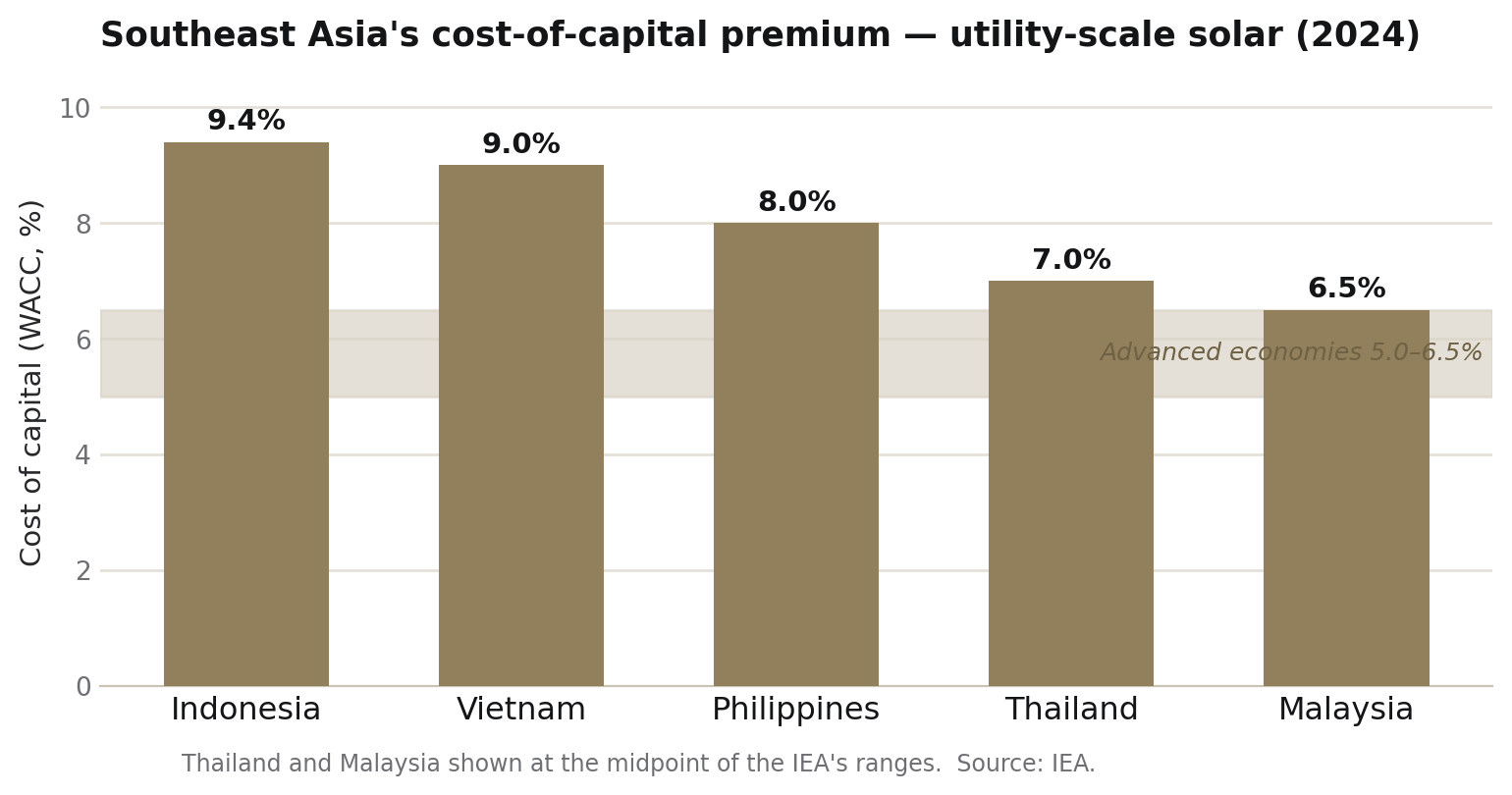
The gap is not hypothetical. With regard to utility-scale solar in 2024, the IEA gives the cost of capital as about 9.4% in Indonesia, 9.0% in Vietnam, 8.0% in the Philippines, 6–8% in Thailand and 6–7% in Malaysia, as compared with 5.0–6.5% in advanced economies. This represents a premium of between 2.5 and 4.4 percentage points, and on a 25-year asset life it is sufficient to determine whether or not a project will be built. [1]
This is evident from the pipeline figures: regional investment in clean energy was around USD 19 billion in 2025, compared to the roughly USD 95 billion per year that the region will need by 2035 — amounting to nearly a fivefold gap — and the limiting factor is no longer the demand for the asset class but the bankability of individual projects. [1][2]
What the premium is really pricing
A high WACC is no market enigma; it is simply the result of several specific and identifiable risks. There is risk concerning the offtaker and the PPA — risk that the utility will pay, in what currency and for how long. Currency risk occurs when revenue is received in ringgit or rupiah while the debt is denominated in dollars. Regulatory and permitting uncertainties also exist, since the timelines and regulations could change during the course of the project. Moreover, there is grid and curtailment risk — this is the point made in Southeast Asia Outlook #2: a project which cannot dispatch cannot pay. Each of these risks is an execution variable and not a fixed characteristic of the market, which means each one can be reduced. [1]
What actually lowers it
- The power purchase agreements should be bankable and the off-takers creditworthy. Long-term, well-structured PPAs form the basis of this approach. The introduction of corporate PPAs — such as Vietnam's Direct PPA framework and Malaysia's Corporate Renewable Energy Supply Scheme — enables developers to sell their power to investment-grade corporate buyers and thus eliminates the utility off-taker's risk at the source. [1]
- The risk premium is reduced and private capital drawn in rather than pushed out by partial risk guarantees, political-risk insurance, and first-loss layers from multilateral and blended-finance vehicles such as the ADB's ASEAN Catalytic Green Finance Facility, the Climate Investment Funds, and the more recent blended-debt platforms. [3][4]
- Debt denominated in local currency and with a longer term. By matching the currency of the revenue with that of the debt, the FX mismatch which inflates the premium is eliminated, and the longer term spreads the capital cost over the lifetime of the asset.
- Regulatory clarity and standardised procurement, along with predictable auctions and transparent rules, reduce the “uncertainty” element of the WACC before any guarantee has been issued — often making it the most cost-effective form of de-risking. [1]
- There is clear readiness with regard to the grid. Since the risk of curtailment is now included in each agreement, having a proven interconnection and a credible dispatch plan actually reduces that risk — they are not merely an engineering consideration done afterwards. [3]
Why this is an execution problem, not a finance trick
No single one of these levers involves financial engineering by itself; each one is concerned with both the execution and the design of the institution — that is, with drawing up the PPA, qualifying the offtaker, ordering the permits, proving the grid connection, and packaging the guarantee. This is exactly the area where returns are made or lost between capital, risk and capability. With a renewable energy asset that requires a large amount of capital, saving just one or two percentage points on the cost of capital is often more valuable to an investor than any operational optimisation that comes afterwards, and this saving is achieved before the financial close, not after.
The point for investors is clear: in Southeast Asia you do not receive compensation for taking on risk which could have been eliminated. It is the projects that have managed to meet their hurdle rate that were the ones which reduced the premium first.
Ezra & Macquarie provides advice to investors and developers regarding bankability, the structuring of power purchase agreements and guarantees, and grid-readiness due diligence throughout ASEAN, thereby converting a risk premium that has already been priced in into a project that can be financed. Explore our capabilities →
Sources
- IEA — “High cost of capital and limited project pipeline hinder clean energy investment in Southeast Asia”.
- IEA — Southeast Asia Energy Outlook 2026 (Executive Summary).
- IEA — Financing the ASEAN Power Grid (Executive Summary).
- Renewable Energy Asia — “Financing the future: how blended finance is powering Southeast Asia's clean energy transition”, March 2026.
Figures for cost of capital are the IEA's 2024 estimates for utility-scale solar. Part of the Ezra & Macquarie Insights series on where capital, risk and capability are moving across Asia.