
The demand curve is no longer grounded in speculation; in Wood Mackenzie's base case it is projected that the load of data centres in Southeast Asia will rise from about 2.6 GW in 2025 to 10.7 GW by 2035, and could go as high as 13.7 GW if three-quarters of the proposed pipeline is constructed. This amounts to an increase of roughly four times over the decade, and Malaysia is at the heart of this development since the country alone accounts for 3.4 GW — approximately 60% — of the total proposed regional capacity and has therefore taken over from Singapore to become the region's data-centre power hub. [1]
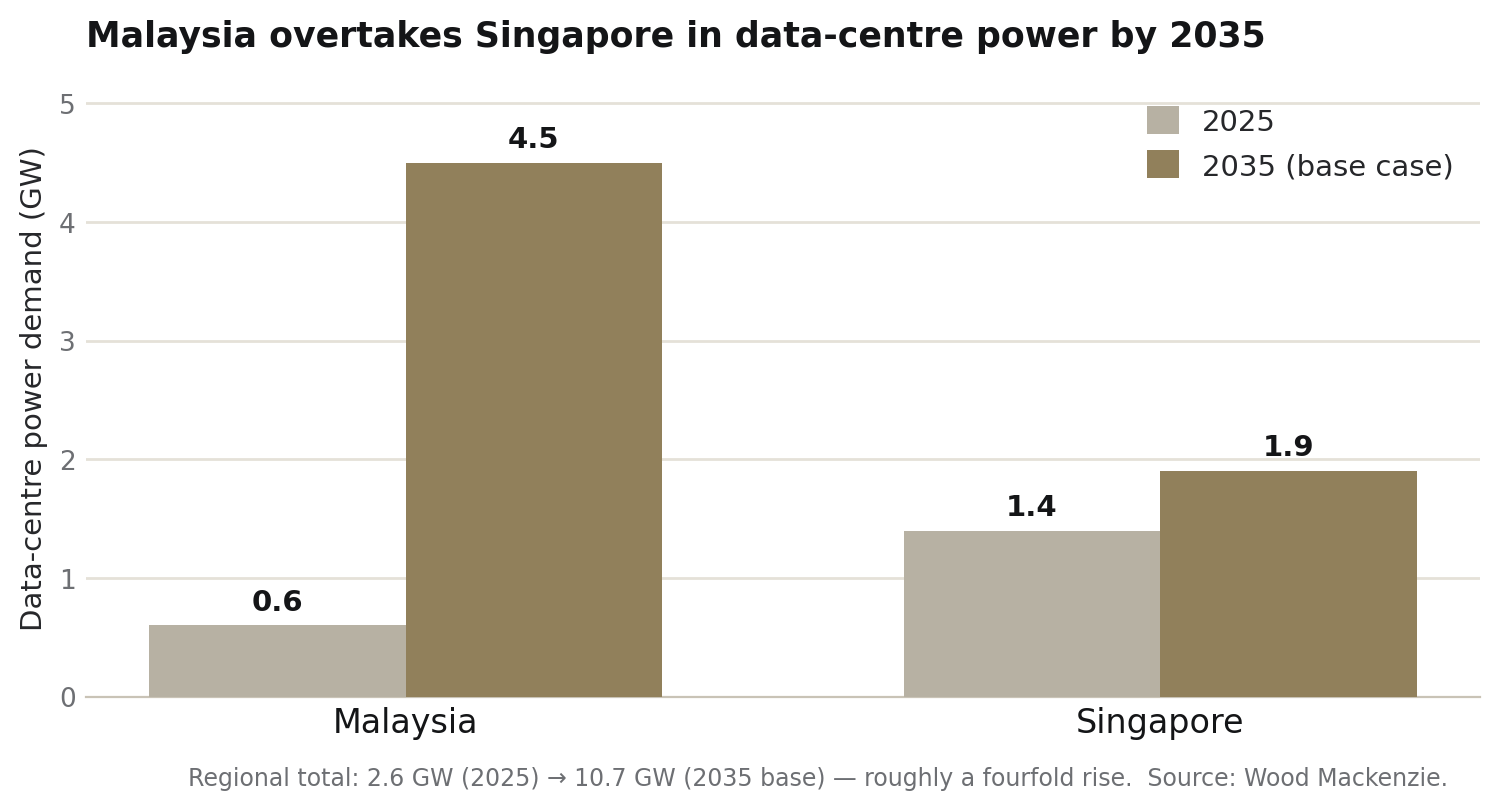
Regarding the use of the grid, data centres are anticipated to represent 7 to 10 per cent of the total increase in power demand in Southeast Asia over the next ten years — that is, 48 to 70 TWh, a quantity equal to all of Singapore's electricity consumption in 2024. Their share of power demand is expected to rise from about 1 per cent to 3 to 4 per cent by 2035, and in the cases of Malaysia and Singapore specifically, data centres might make up more than 10 per cent of the country's electricity. This is not merely a simple rounding error; it reflects the arrival of a new type of industrial load which is coming on quickly and is concentrated in a small number of areas. [1][2]
The collision: new load, tired grids
The problem lies in the timing. As we stated in Southeast Asia Outlook #2, the present grids are already acting as a bottleneck in achieving the energy transition — even though demand has gone up, grid investment has fallen from about USD 15 billion in 2015 to USD 12 billion by 2025, and between 2021 and 2025 half of the renewable energy projects in Vietnam, Thailand and Indonesia were cancelled or brought to a standstill. One banker remarked that the power grid's strength “is really not there”. The present boom in AI technology is directly targeting that weakness. [3][4]
For hyperscalers or companies that provide co-location services, power has now become a key consideration in their decision-making process; speed-to-power — that is, how quickly a site can get access to reliable and clean electricity — has taken over as the main factor when deciding where to place capacity, superseding land, tax, or even connectivity.
What it means — for investors and operators
- The grid should be underwritten as a whole, not just the site; today interconnection queues, substation headroom and curtailment history should be included on the first screen of any data-centre diligence and not kept for the final engineering annex.
- Make sure that power is secured both by contractual means and by physical arrangements. Currently, corporate power purchase agreements, generation and storage situated behind the metre, and access to green tariffs are what set a viable project apart from one that will be stranded.
- Keep an eye on the policy signals: rather than attempt to secure each megawatt, governments are now concentrating on directing it, with approval given more frequently on the basis of grid-readiness conditions, efficiency standards and rules about location.
- Treat the acquisition of power as a skill that can be put into action. The teams that achieve success are those who deal with utilities, regulators and grid operators in just the same skilled way as they do with capital. It is this same gap in capability that decides the outcome of each major project in the field.
Ezra & Macquarie assists investors and operators in reducing the risks connected with data-centre and power projects by providing grid-readiness diligence, power procurement, and market-entry strategy services in ASEAN. Explore our capabilities →
Sources
- Wood Mackenzie — “Southeast Asian data-centre power demand is set to explode”.
- Ember — “From AI to emissions: aligning ASEAN digital growth with the energy transition”.
- Climate Change News — “Southeast Asia's fragile grids threaten billions in clean energy investment”, 5 August 2026.
- IEA — Southeast Asia Energy Outlook 2026 (Executive Summary).
A Signal Note from Ezra & Macquarie — short, fast reads on the developments shaping Asia's energy and infrastructure agenda. Figure 1 uses Wood Mackenzie base-case figures.